trawlkit · Trawl Design Lab
From a classroom Excel spreadsheet to an open lab for designing trawl nets, which works on a phone even without signal.
Blue economy and fisheriesAI-powered software
Open the app in a new tab ↗Book (Jupyter Book, Spanish) ↗Repository ↗PyPI: trawlkit ↗Zenodo (DOI) ↗
- 697values from the original spreadsheet reproduced (rtol 1e-6)
- 28spreadsheet errors documented, 24 fixed
- 13net drag methods
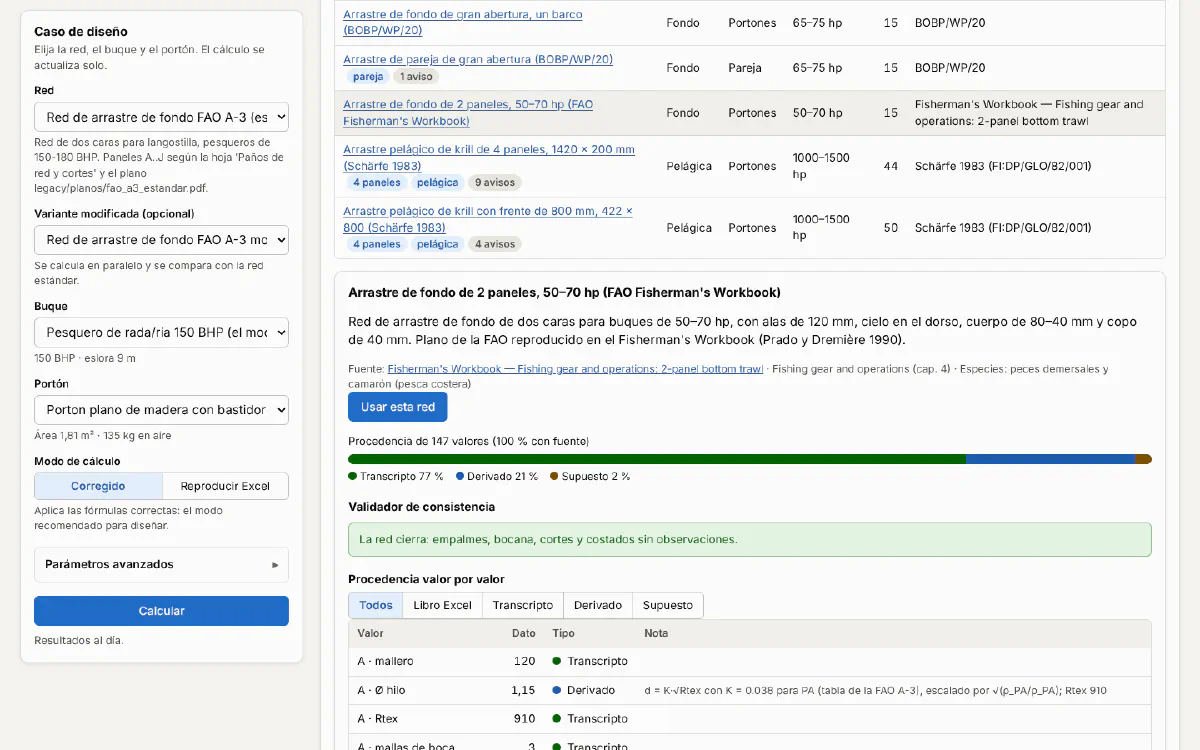
- 35nets in the catalogue, sourced value by value
- 1,466components from 18 manufacturers plus generics
- 41book chapters, 170 references
Try it here: the real app
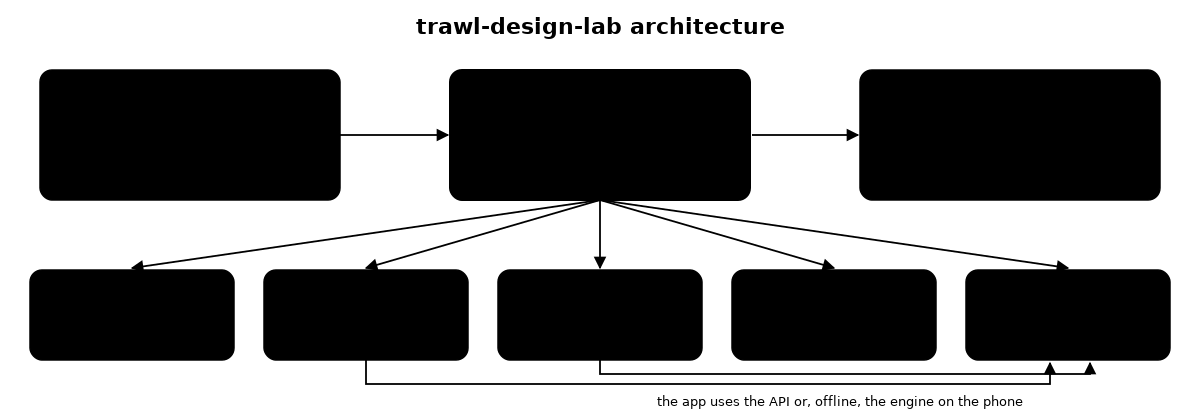
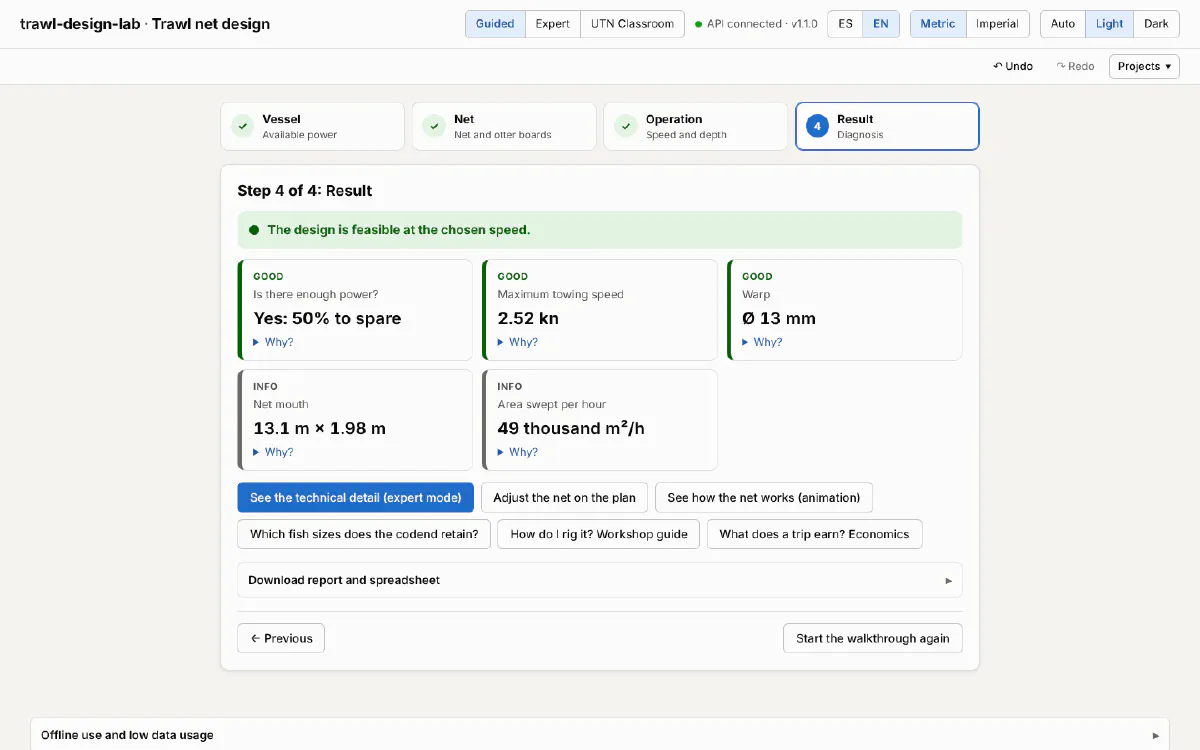
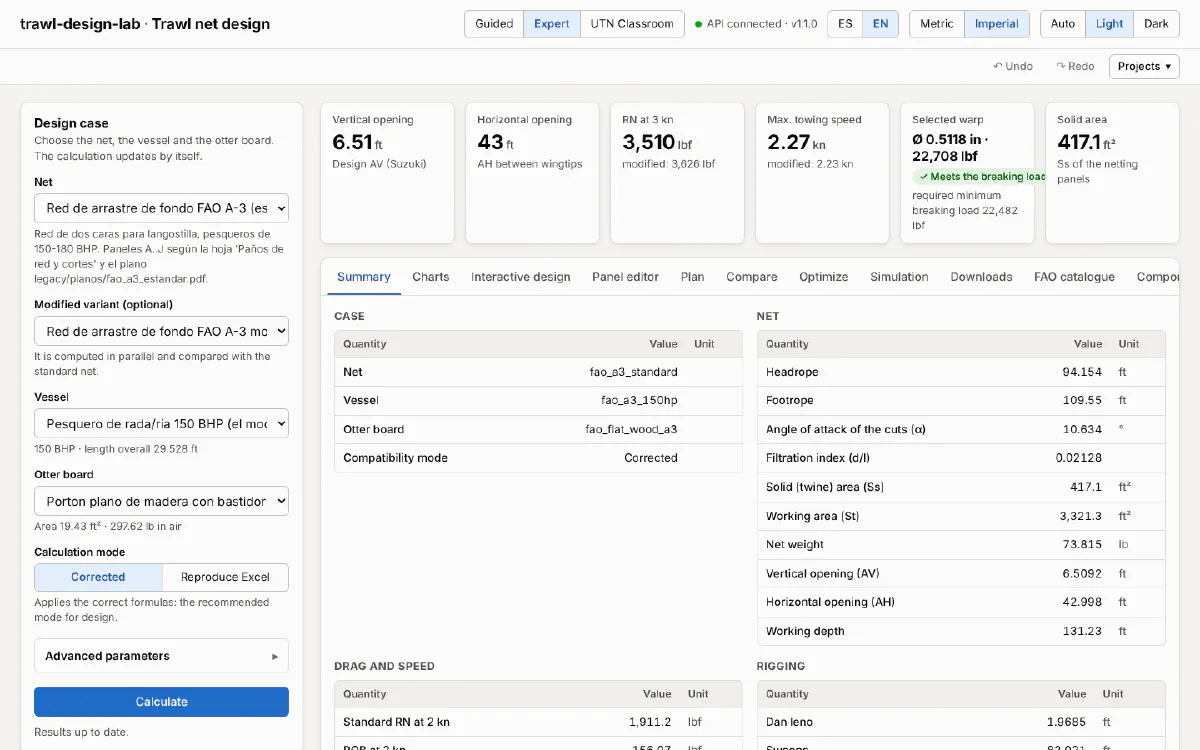
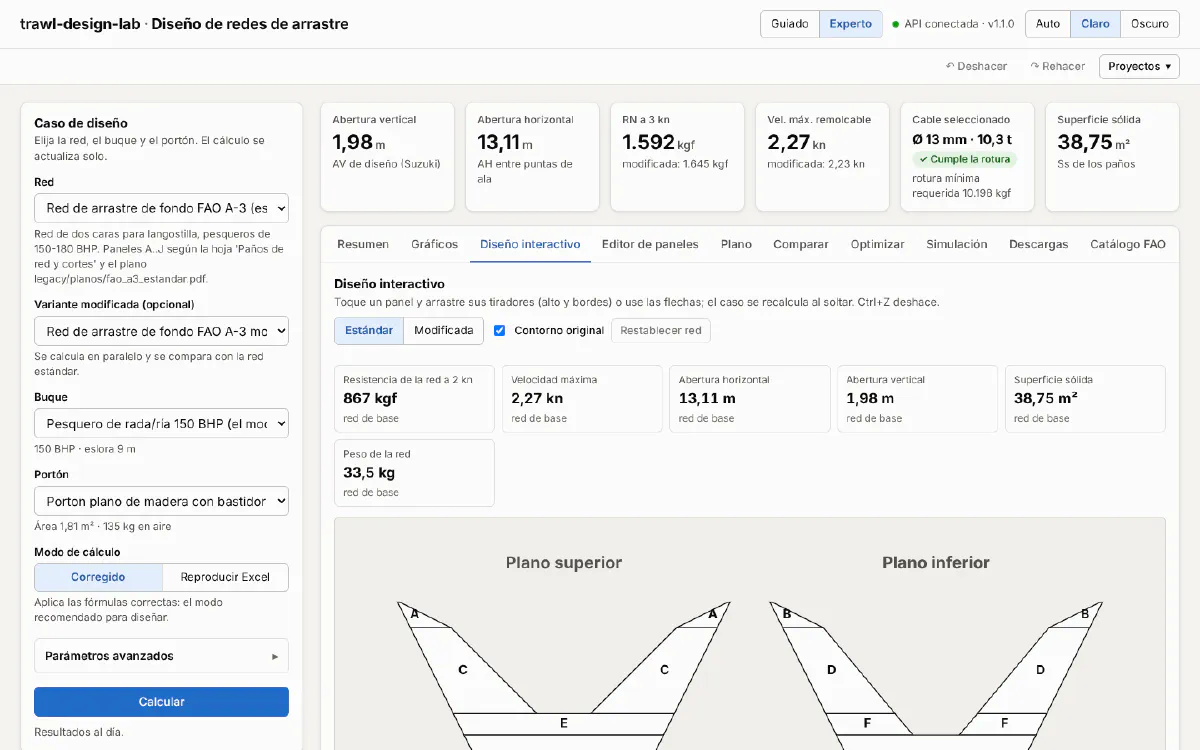
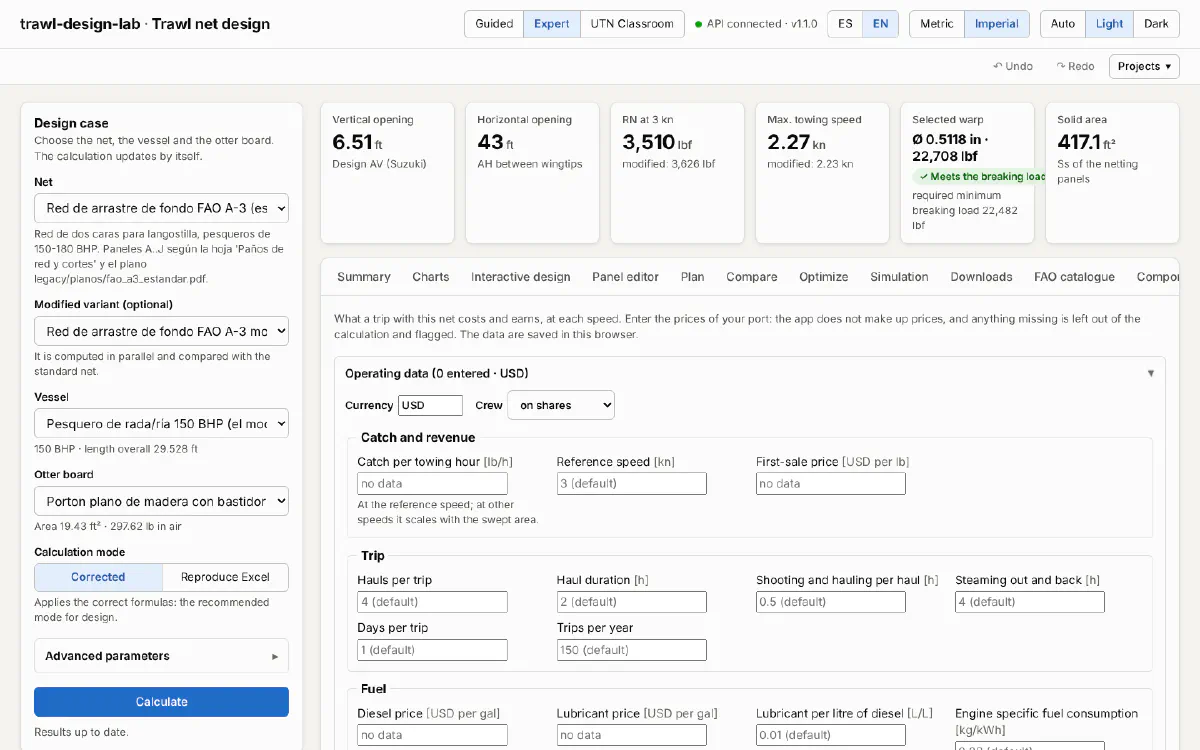
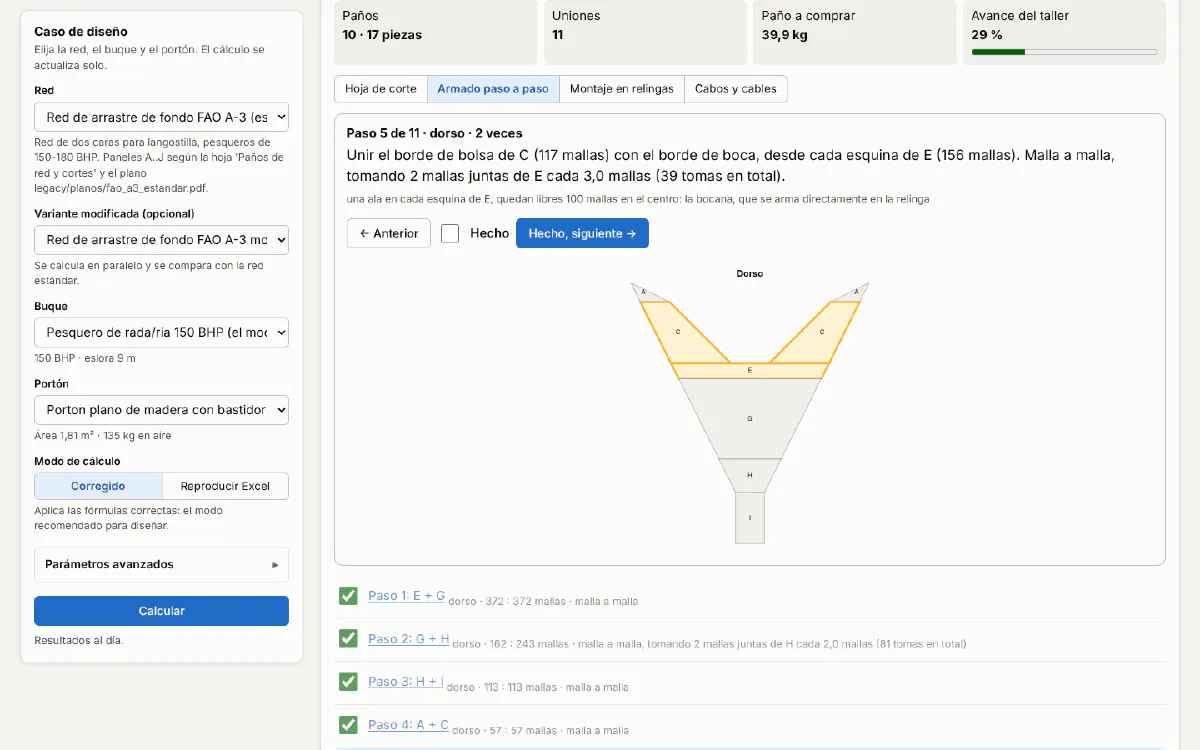
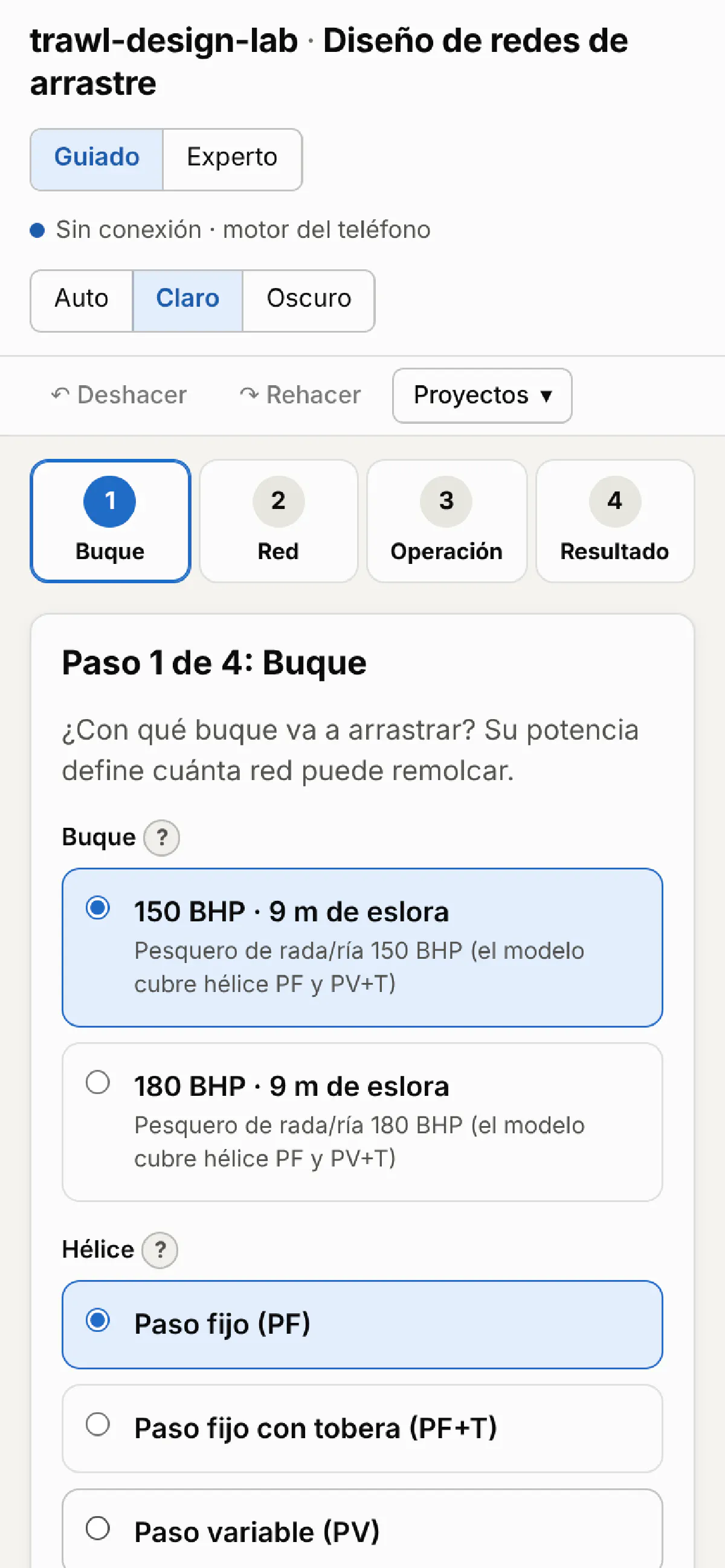
This is the full application, not a mock-up. It calculates with the project's API and, when the API is unavailable (it sleeps after a while without use), with the same Python package running in your browser with Pyodide. Language (Spanish or English) and units (metric or imperial) are at the top right.
The problem
Choosing a trawl net is an engineering problem: it has to be one the vessel can actually tow, at a speed that catches fish, with doors, warps and floats that keep it open, and at a cost that pays back. In practice, that calculation lives in spreadsheets that inherit their own errors, or in the experience of whoever rigs the net on the quay.
Where it comes from
The project started in the Fisheries Engineering classrooms of UTN in Tierra del Fuego: sizing the FAO A-3 net for the 150-180 HP vessels of the Beagle Channel, solved in an Excel workbook of about 5,500 formulas. That workbook is now trawlkit: every formula migrated and validated against the spreadsheet, its errors documented and fixed, generalised to any net and extended with catalogues, optimisation, simulation and an app for use on the quay.
What I built
- Calculation engine (
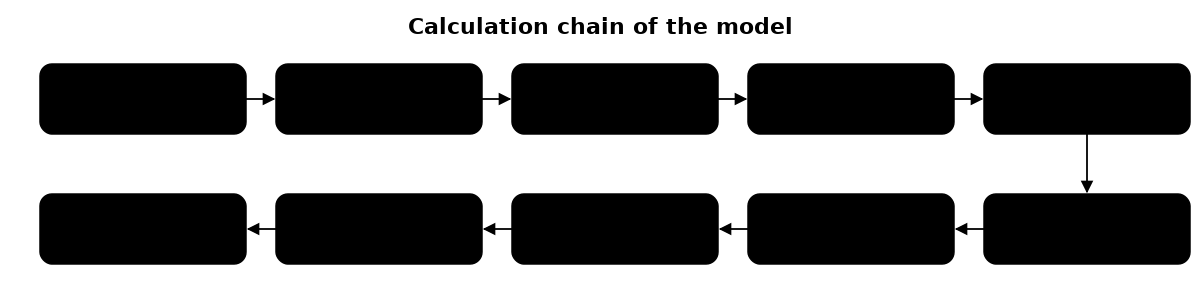
trawlkit): available power, panels and cuts, net mechanics and dimensions, drag by 13 methods, doors and bridles, openings, floatation and ballast, warps and the towing speed window. - Two calculation modes:
excelreproduces the original workbook’s number to validate the migration, andcorrectedapplies the right formula. Every fix is demonstrated, not assumed. - Installable web app that works offline: the same engine runs on the phone with Pyodide, with parity against CPython (rtol 1e-9). A guided mode for skippers and technicians and an expert mode for engineers.
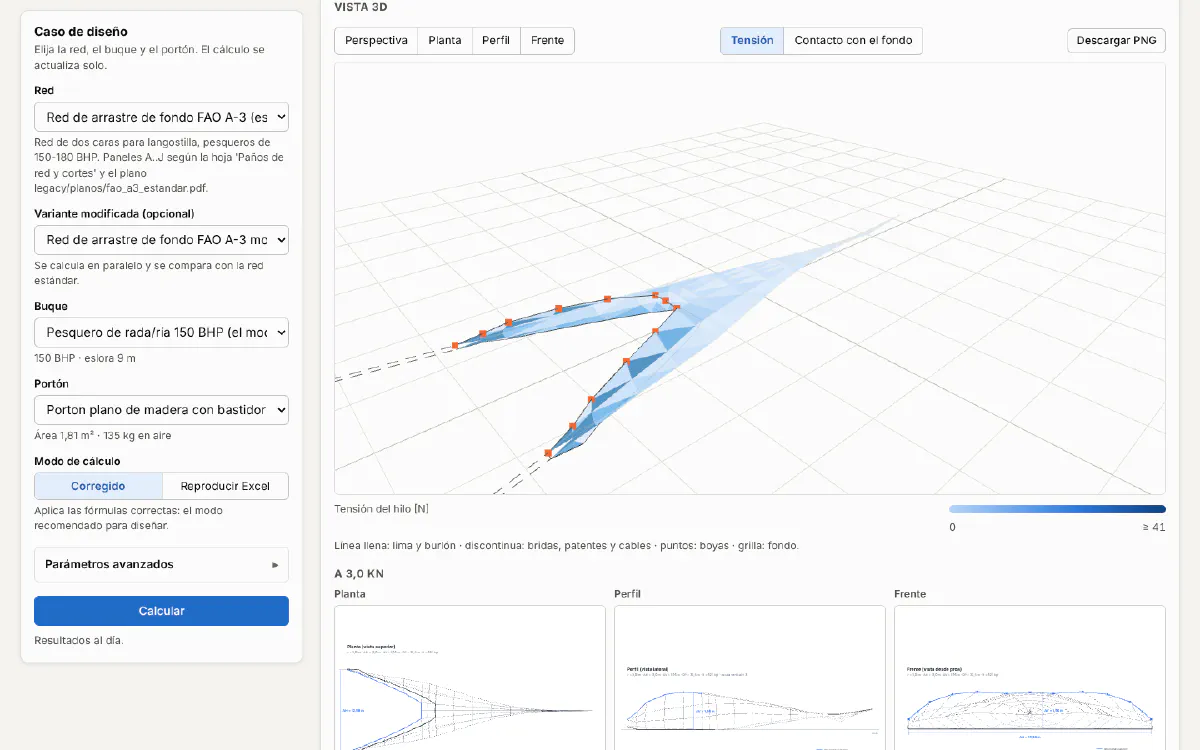
- Simulation of the 3D equilibrium shape of the net, validated against DynamiT, and codend selectivity (diamond, T90, square mesh) by species.
- From design to workshop: bill of materials with cost, cutting sheet, joins and rigging, as a PDF and step by step on the phone.
- Operating economics: fuel, catch and margin at each speed, and the most profitable speed.
- UTN classroom: exercises with changing data and automatic marking, guided labs and a classroom with courses, assignments and grades.
- Reproducible book of 41 chapters whose numbers come from running the engine, and an API with 79 routes.
How it is built
Python 3.11+ with Pydantic and pint for units, FastAPI for the API, a React app that loads the engine in a Web Worker with Pyodide, and Jupyter Book for the documentation. Continuous integration with pytest, ruff and mypy; the README indicators are checked by a test. Code under the MIT licence; documentation and data under CC BY 4.0. Published on PyPI with a DOI on Zenodo.
Who it is for
Fishers and skippers, net technicians, fishing schools, and fisheries students and engineers. It is dedicated to the three UTN regional faculties that teach Fisheries Engineering: Tierra del Fuego, Chubut and Mar del Plata.
Technologies
- Python
- FastAPI
- Pydantic
- SQLAlchemy
- SciPy
- Plotly
- Docker
- pytest
- hatchling
- PyPI
- Zenodo
- CITATION.cff