Research project PP9884: freeze-drying food from Tierra del Fuego
Preserving what is produced in southern Patagonia without losing what makes it valuable: reproducible protocols that a regional producer can apply.
- 261valid observations: 3 pre-treatments, 10 times, 3 months
- 48 hoptimal time with frozen or deep-frozen samples (72 h fresh)
- 0.92R² of the ANOVA (pre-treatment, time and month)
- p = 0.10no significant month effect: reproducible results
- 13people on the team: 6 lecturers and 7 students, 4 with grants
Try it: the drying kinetics of rhubarb
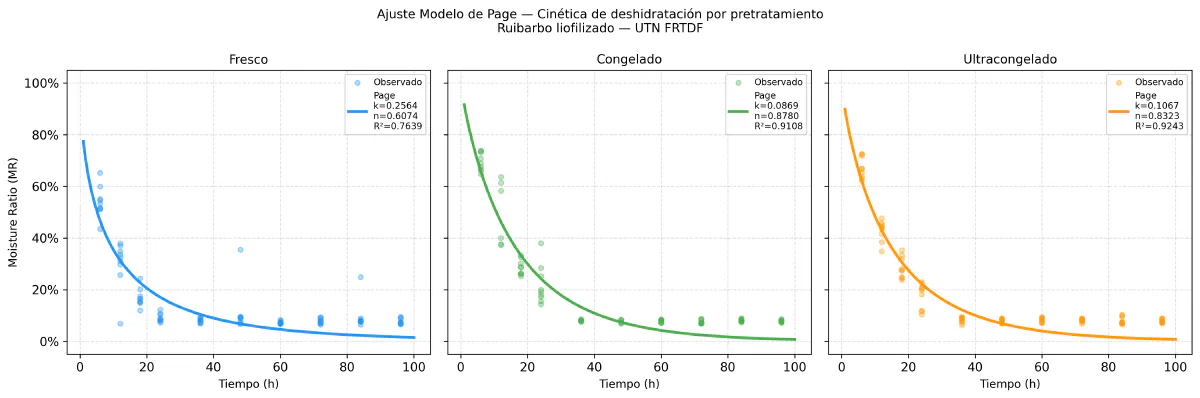
The fraction of water still to remove, MR(t) = exp(−k·tⁿ), with the parameters fitted to the 261 observations of the project for each pre-treatment. Move the time and compare.
Page parameters from resultados_clave.md in the project repository. The fit is better for pre-frozen samples (R² > 0.91) than for fresh ones (0.76): pre-freezing makes the cell structure more uniform and the drying more predictable. The observations level off at about 6-10 % residual moisture while the model tends to zero, so beyond about 40 h it should not be read literally.
Open the animation in a new tab ↗ · In Spanish, from the group's website.
The project
Research project PP9884 at UTN Tierra del Fuego (2023-2026, extended) studies freeze-drying, drying by sublimation at low pressure, to preserve and add value to locally produced food. I led it within the QA3DS R&D group (Chemistry Applied to the Environment, Food and Sustainable Development), with a team of lecturers in chemical and industrial engineering and science, and student grant holders.
Of the three planned matrices, rhubarb went ahead; samphire and sea urchin were dropped.
What we found
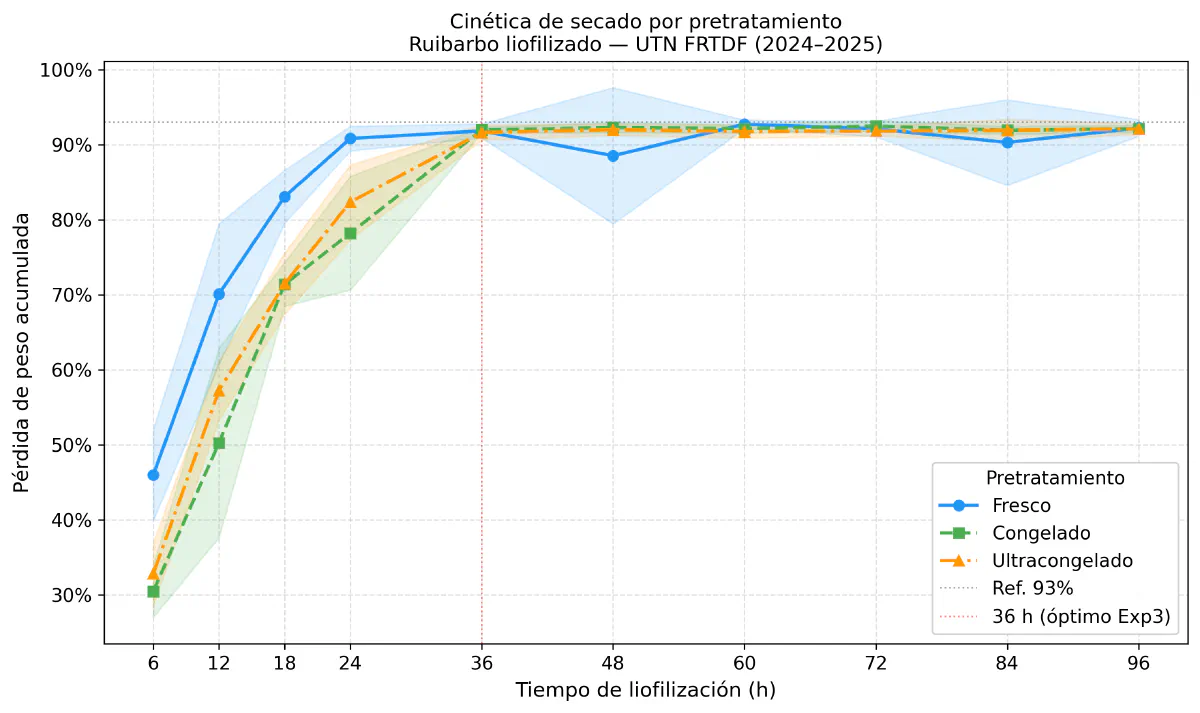
- The optimal time is 48 hours with frozen or deep-frozen samples and 72 with fresh ones; in practice 36 to 48 hours is recommended. About 92 % of the weight is lost.
- Pre-freezing makes drying more predictable: the Page model fits with R² of 0.91 and 0.92 against 0.76 for fresh samples.
- From 36 hours the three pre-treatments are equivalent (Kruskal-Wallis, p = 0.51), although at 24 hours the fresh samples are ahead.
- The results reproduce: the month of the trial has no effect (p = 0.10), and neither do the equipment conditions within their range.
How we worked
A reproducible notebook compiles the trials, excludes invalid observations with their reason and produces the figures and a key-results document from which every published figure comes, including those on the group’s website. An ETL loads the data into SQLite for a monitoring dashboard. The laboratory protocol, the quality framework and the scale-up study are finished; the technical-economic manual, the final report and a preprint are still in preparation. The project material is in Spanish.