cfp-audit-intelligence
Are fishing quotas set according to the science? A platform that reads the public minutes, analyses them with AI and checks them against INIDEP advice and actual catches.
AI-powered softwareBlue economy and fisheriesAI and data science
- 1,003tests in CI
- 12documented architecture decisions (ADRs)
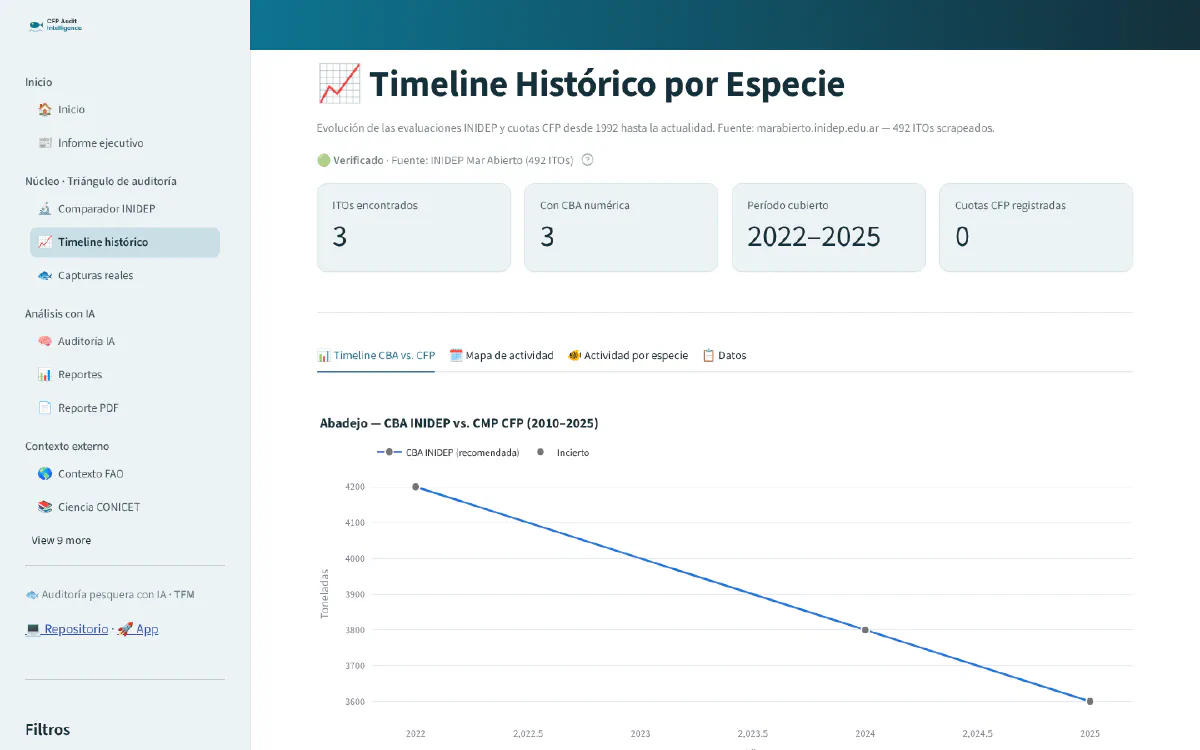
- 492INIDEP technical reports catalogued
- 18pages in the Streamlit dashboard
- 8public sources integrated (CFP, INIDEP, SIPA, FAO, CONICET, CONAE…)
- ThesisMaster's in AI Development, BIG school, passed in 2026
Presentation and video
The final project presentation and the demo video, both in Spanish. The live app runs on Streamlit Community Cloud: after a while without use it sleeps and takes a minute to wake up.
Use the arrow keys to move between slides.
The problem
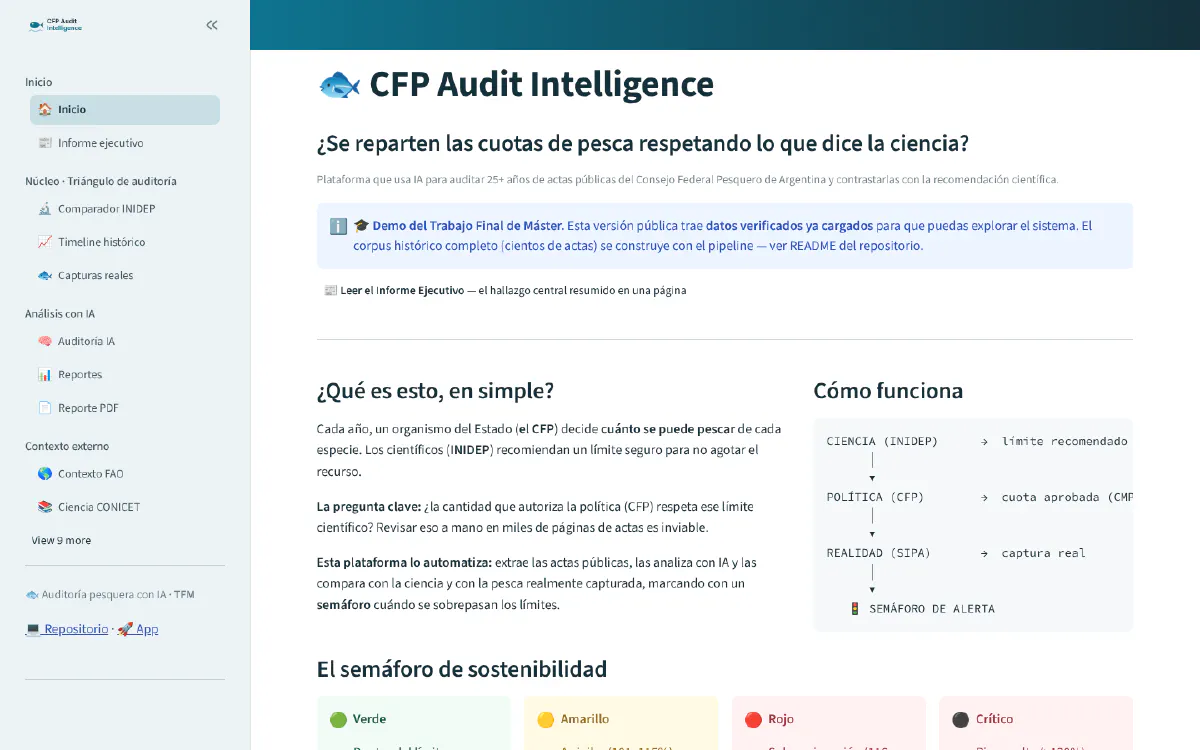
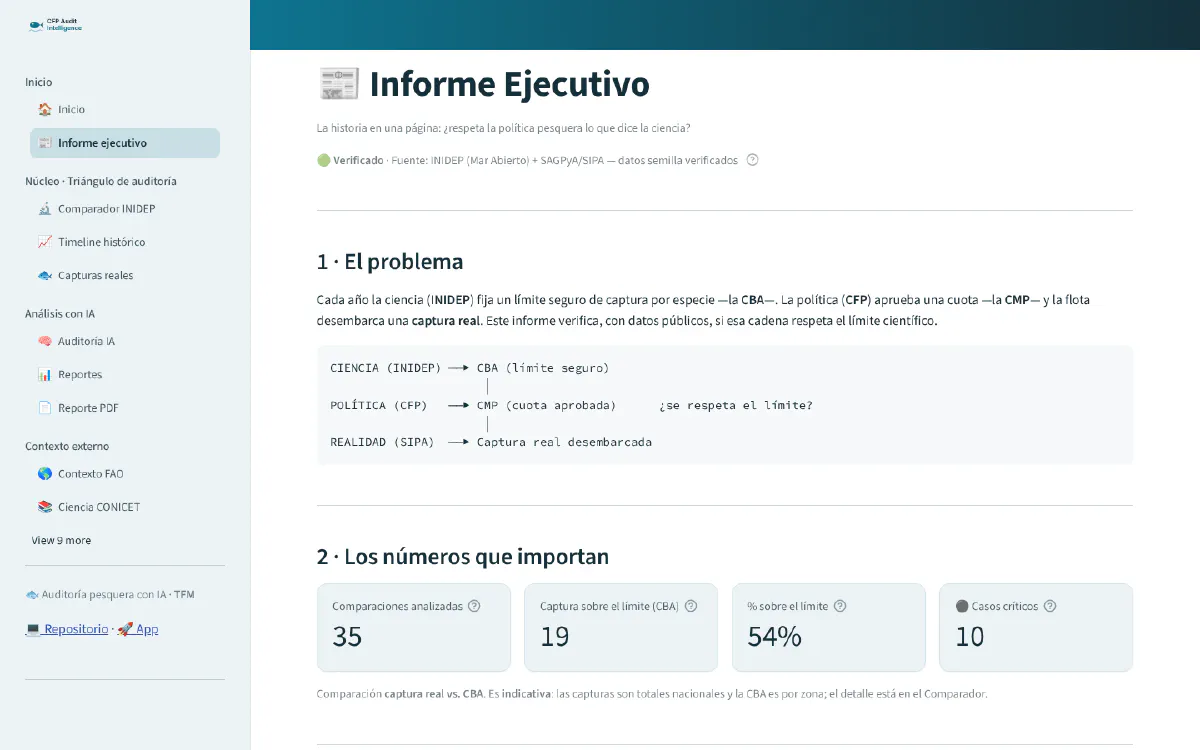
Every year Argentina’s Federal Fisheries Council (CFP) decides how much of each species can be caught in the Argentine Sea. Scientists at INIDEP recommend a safe limit, the Biologically Acceptable Catch (CBA), and Law 24,922 requires it to be taken into account. The question is simple: does what policy authorises respect that limit? Answering it by hand means reading thousands of pages of PDF minutes and cross-checking them with technical reports and landing statistics.
What I built
- Acquisition from eight public sources: CFP minutes, INIDEP technical reports (through the DSpace API of its repository), actual catches from SIPA, FAO FIRMS, CONICET publications, closures from INIDEP’s geoviewer, and satellite fishing effort from CONAE and Global Fishing Watch.
- Processing of the minutes: cascading extraction (pdfplumber, PyMuPDF and Tesseract OCR), a parser for resolutions, votes and quorum, and fisheries named-entity recognition with spaCy (species, companies, zones, vessels).
- Knowledge base and RAG: ChromaDB with multilingual embeddings and an audit engine with multiple LLM providers (Anthropic with prompt caching, or any OpenAI-compatible API).
- The audit triangle: a comparator of INIDEP’s CBA against the approved quota and actual catch, with a four-level traffic light, configurable alerts and a relationship graph between companies, resolutions and council members.
- Products: an 18-page Streamlit dashboard, a FastAPI REST API and an executive PDF report.
Responsible AI
The project documents its limits as much as its capabilities: a Model Card and a Datasheet following Mitchell (2019) and Gebru (2021), groundedness metrics to check that model answers rest on the sources, prompt versioning, and an ethical-limits ADR: it is a descriptive analysis tool on public data, not a tool for legal decisions or accusations.
How it is built
Python with a layered, ports-and-adapters (hexagonal) architecture, 12 ADRs, 1,003 pytest tests and CI on GitHub Actions, Docker, and deployment on Streamlit Community Cloud. It started as a personal project before the master’s and was consolidated as the final project of the Master’s in AI Development at BIG school: the step from data science to maintainable software development.
Technologies
- Python
- FastAPI
- Streamlit
- ChromaDB
- OpenAI
- Anthropic
- sentence-transformers
- SHAP
- SQLAlchemy
- PyTorch
- Plotly
- Docker Compose